Keeping the same plant pot for ten years isn't a "small" decorating choice. It's a way of living with fewer objects, but with better pieces. The ones you actually use, know inside and out, and are happy to see every day.
When an object is durable and made in France, it's not just a reassuring label. What matters is what it actually represents: a carefully chosen material, a recognized manufacturer, controlled finishes, and a piece that won't go out of style with the first rearrangement.
Made in France: what that really changes
Behind every decorative object, there is always a chain of very concrete decisions: where the material comes from, how it is transformed, who works with it, how the piece is checked, and what is planned if one day an element needs to be repaired or replaced.
When this production chain is based in France, everything becomes easier to follow. Distances are shorter, communication with the workshop is more direct, and production runs are often smaller. As a result, a color, a finish, or an assembly detail can be adjusted without months of waiting.
This close connection is also evident in the coherence of a collection. The proportions are just right, the edges are clean, the surfaces are even. This is often what distinguishes a merely pretty object from a piece that truly makes a statement in an interior.
Of course, “made in France” doesn't solve everything. Some materials are still imported, costs are higher, and there are real constraints. But it's often a good indicator of traceability and quality control, two solid foundations when you're looking for an item made to last.
Durability: beyond "it doesn't break"
Durability and sturdiness are often confused. In reality, a durable object is above all an object that you keep. Because it remains practical. Because it remains beautiful. And because it continues to find its place, even when your interior changes.
To get a clearer picture, we can look at three things.
Durability is key. An object can be beautiful, but if it complicates everything on a daily basis, it will end up at the back of a cupboard. A bookend that's too light and slips, a plant pot that gets marked the first time it's moved, a lamp that's a pain to dust: these are the details that decide whether we keep the object or not.
Then there's the durability of the materials. Some surfaces dull, others develop a patina. Some colors fade quickly, others gain depth in the light. The goal isn't to avoid all marks, but to choose a material that ages well, and an aging process that's acceptable.
And then there's aesthetic durability. A well-designed object has clean lines, perfect proportions, and a presence that transcends trends. When the form is precise, it ages gracefully without ever looking dated.
Bio-based materials: responsible, but also strong
As soon as we talk about sustainable products, the question of materials quickly arises. Bio-based materials, derived from renewable resources, allow us to reduce the proportion of fossil fuels. This is important, but it's not the only issue.
What also matters is how they perform in a home: their stability, feel, reaction to light, and resistance to impacts and moisture. A bio-based material can be very strong if its formulation and installation are carefully done. Conversely, a "conventional" material chosen solely for its price can age quickly and poorly.
It's all about finding the right balance between the material and its intended use. A plant pot doesn't have the same lifespan as a lamp. An object placed high up doesn't experience the same wear and tear as something handled every day.
A good habit to check is whether the brand truly explains its choices. A clear page on materials and manufacturing , with properties, limitations, and reasons, is often a good sign.
When design lies in the details we don't see
You can recognize a well-designed object by a simple feeling: it fits perfectly. It stays put, it doesn't move, it looks like it belongs. And while that may seem obvious, it's rarely a coincidence.
Proportions, first and foremost. A durable piece is almost never a “standard” size. It’s designed to be present without becoming overwhelming. What we call simplicity in design is often the result of numerous trials.
Next, the assembly. Even though you can't see the fasteners, you can feel the quality: no play, no vibration, a quiet solidity. When a studio designs and manufactures in the same place, improvements are made continuously, with very concrete feedback.
Finally, color. A shade isn't a "last resort." It's a decision about volume. When well-chosen, a strong color can last a very long time because it becomes a focal point. In a minimalist interior, it adds depth. In an already rich decor, it should complement the existing color scheme without overwhelming it.
Before you buy: a few simple guidelines
Buying more responsibly shouldn't feel like an exam. With a few guidelines, it's easy and practical, without buying blindly.
First point: transparency. Where is the object designed, where is it manufactured, and with what materials? When this is clearly explained, it's often a good sign. A page like "Materials and Manufacturing" allows you to understand what you're buying, beyond just the photo.
Second point: what happens after the purchase. A durable item accepts the idea that one day it might fall, get damaged, or simply no longer be suitable. At Les Arcadiens, we've set up a second-life program: parts can be taken back, ground up, and the material reused, with a €10 voucher and return shipping costs covered.
Third point: the simplicity of returns. Easy returns prevent impulse purchases. And they also allow an item that doesn't fit to be put back into circulation, rather than leaving it to gather dust in a closet.
Minimalism and expressiveness: there's no side to choose between.
Minimalism and expressiveness are often seen as opposing forces. In a real home, the two coexist very well. We need calm, but also a few rooms that add character.
Sustainable minimalism is not about white everywhere. It's about an economy of means in service of use: an object that is immediately understandable, that doesn't tire the eye, and that ages well because it doesn't seek effect.
Lasting expressiveness, on the other hand, takes on a form, a geometry, a color. It can stand the test of time if it is precise. A confused form ages quickly. A clear form remains valid.
The choice depends mainly on your daily routine. If you frequently rearrange your space, a statement piece can become your focal point. If your space is already very cluttered, a simpler, well-designed room will bring a sense of calm.
Objects that play with light, volume, and use
Objects that we keep for a long time often have one thing in common: they are useful, but they also contribute something to the room. They structure, they illuminate, they give a presence, without requiring us to change everything around them.
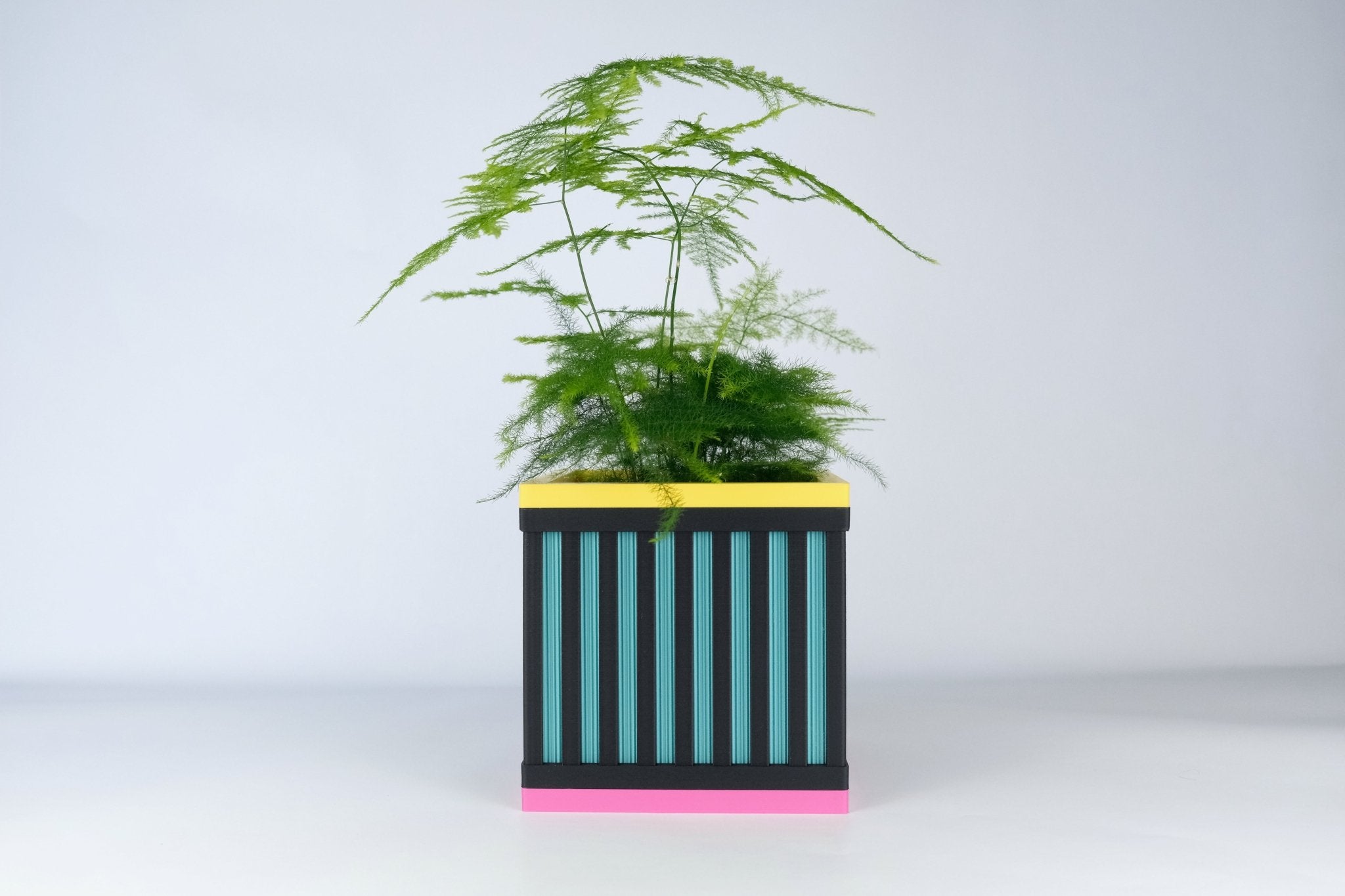
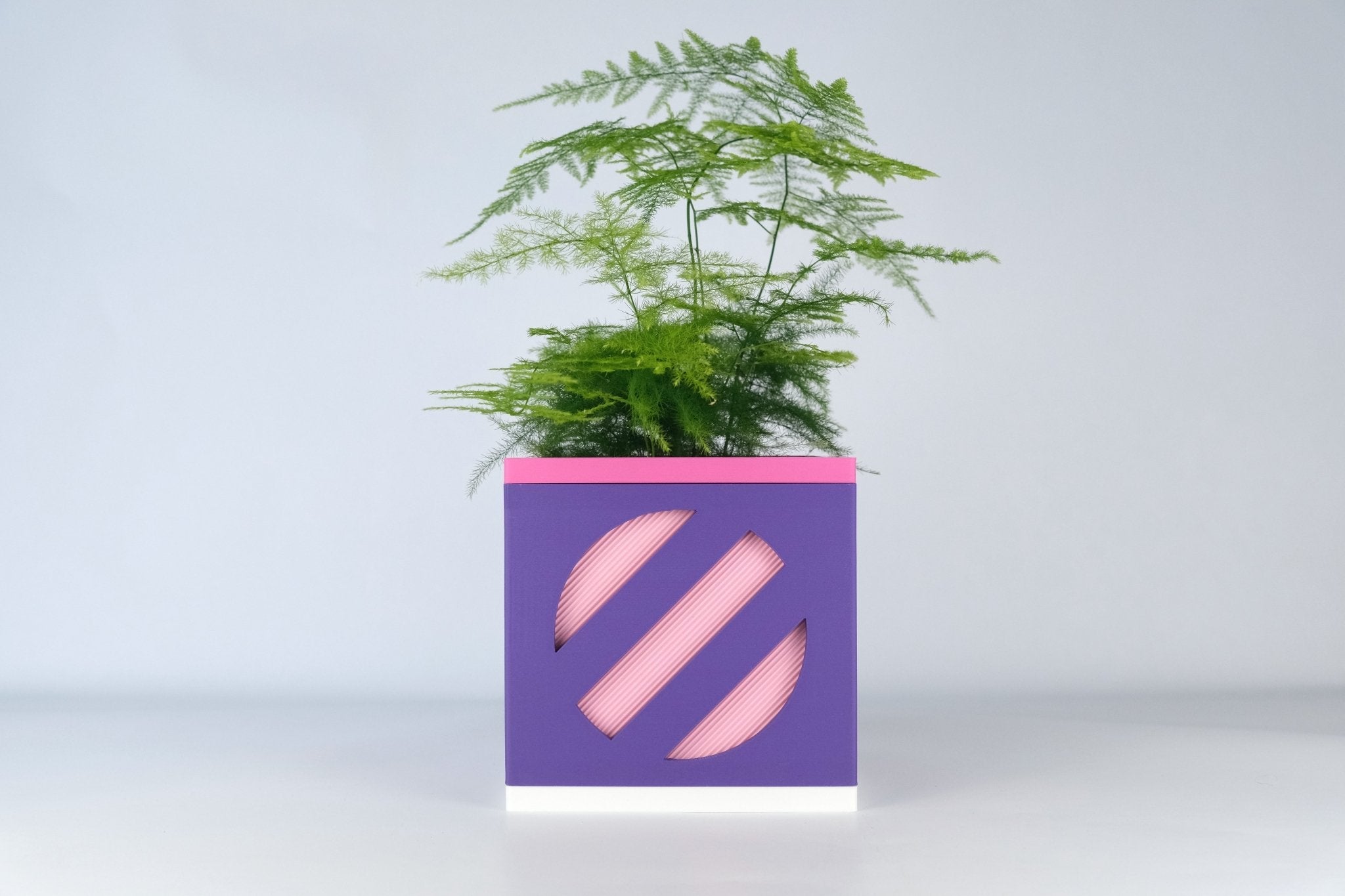
A plant pot can simply hold a plant. But it can also create a real silhouette, add rhythm to a shelf, introduce a specific color, and make a plant look more beautiful effortlessly.
A bookend can hold a row of books. And then, one day, the library changes, and it remains there, alone, like a small sculpture. This ability to change its role is often what allows an object to endure through the years.
A lamp, like Interstice , is judged as much by its light as by its presence when switched off. A good lamp makes a space more inviting in the evening without being harsh.
This is precisely the ambition of the Les Arcadiens studio: to design graphic, durable objects, made locally, and designed to last a long time in your home. All our pieces are designed and produced in our workshop in Caen, Normandy, primarily using bio-based materials.
Price: what you actually pay
An item made in France often costs more than a standardized, mass-produced item. The real question isn't "is it expensive?" but "what am I paying for with that price?"
You are financing small-batch production, workshop time, prototyping, and often more demanding finishing. You are also financing controlled production, without unnecessary overstocking, and a level of control that prevents disappointing purchases.
Conversely, a less expensive item can be useful for testing a color or furnishing a temporary space. Sustainable buying isn't a dogma. It's a way of allocating your budget to the pieces you truly want to keep.
As soon as an object becomes a visual landmark in your home, the balance shifts. You'll see it every day. It must stand the test of time in terms of material, form, and durability.
Avoid the showroom effect at home
Incorporating a statement piece doesn't mean turning your living room into a showroom. On the contrary. A statement piece often has more impact when it's not overwhelmed by other objects.
Choose a stable spot: the entryway, a shelf, a desk, a bedside table. These are areas we pass through several times a day. Leave a little space around it too. That's often enough to give the object presence without overdoing it.
Next, observe the light. A geometric shape casts different shadows depending on the time of day. A color changes depending on the exposure. Sometimes, moving the object just ten centimeters is enough to find the right spot.
And then there's a very simple detail: we keep for a long time what we use, what we maintain, what we really look at. Choosing fewer objects, but better ones, is also about that.